
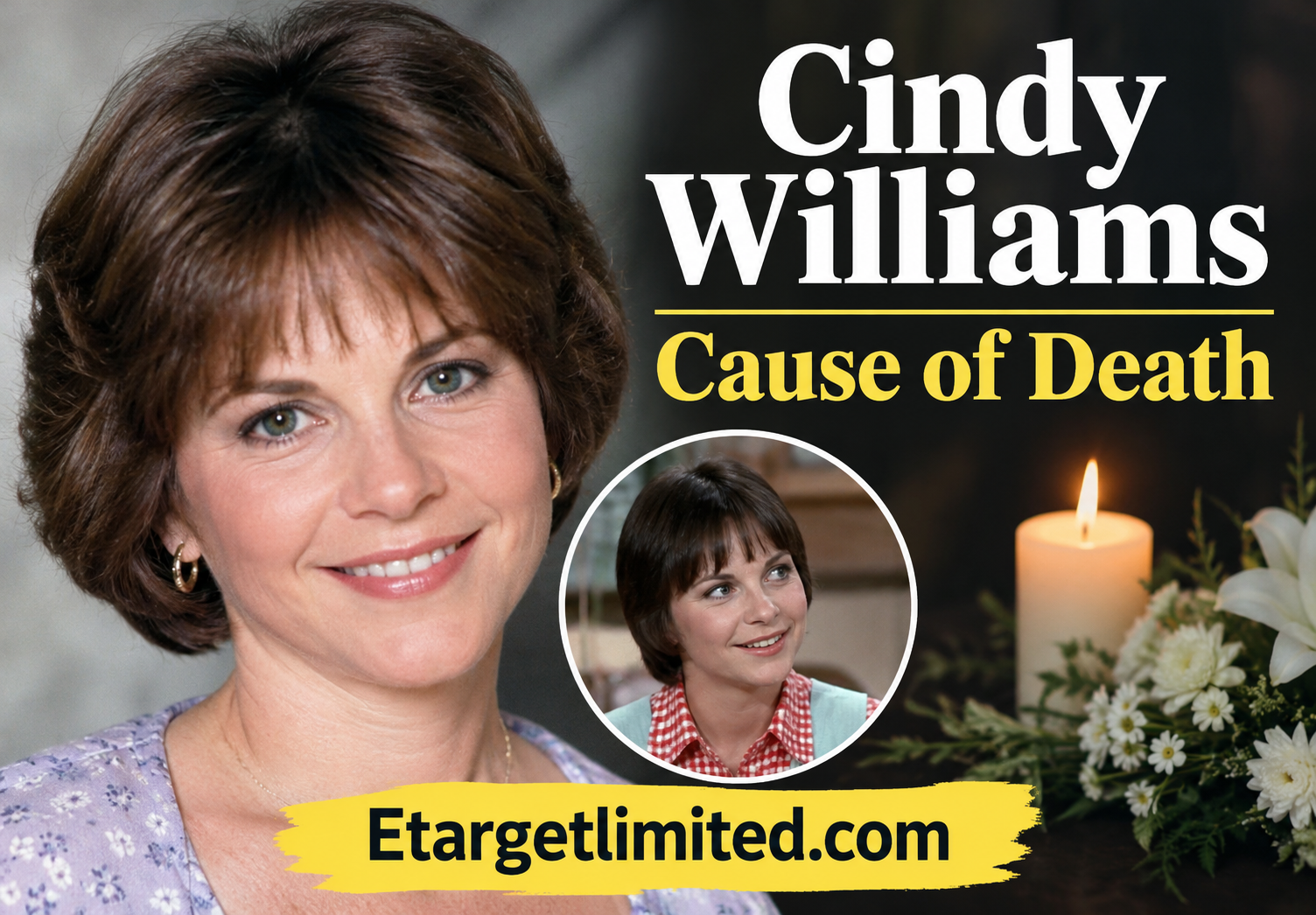
Cindy Williams, the actress who became a household name as Shirley Feeney on Laverne & Shirley, died on January 25, 2023, at the age of 75. Her death followed a brief illness, according to her family. But what exactly caused her death? The answer requires separating the confirmed details from claims that have circulated online.
What Was Cindy Williams’ Cause of Death?
The publicly confirmed information is that Cindy Williams died after a brief illness in Los Angeles, California. Her children, Zak and Emily Hudson, announced her death on January 30, 2023, through a statement released by family spokeswoman Liza Cranis.
However, her family did not publicly identify a specific medical condition as the cause of death in that announcement. Major news reports covering her passing also described the illness as brief without establishing a particular diagnosis.
This distinction matters. A report that someone died following an illness does not automatically reveal the underlying disease. Without reliable confirmation, naming a specific condition would turn an unanswered question into an unsupported claim.
When Did Cindy Williams Die?
Williams died on Wednesday, January 25, 2023, in Los Angeles. She was 75 years old.
The news became public five days later, when her family shared the announcement. The statement described the loss as deeply painful and remembered Williams as a generous person with a remarkable sense of humor.
Her family also highlighted her lifelong commitment to rescuing animals, her artistic work, and her faith. These details offered a glimpse of the person behind the familiar television character.
The announcement attracted widespread attention because Williams had spent decades entertaining audiences. For many viewers, she was not simply a television actress but part of a comedy partnership that had become a lasting piece of American pop culture.
Was Cindy Williams’ Death Linked to a Specific Disease?
What reliable reports actually confirm
The central fact remains straightforward: Williams died after a brief illness, but the public announcement did not disclose a specific diagnosis.
The Associated Press reported her death and summarized her career, while CBS News also covered the announcement. Neither report established a named disease as the confirmed cause of death.
Consequently, claims that attribute her passing to a particular illness should be treated cautiously unless they can be traced to a credible source with direct knowledge of the circumstances.
What about online speculation?
Searches about celebrity deaths often lead to websites and social media posts that offer a specific medical explanation. Sometimes these claims are repeated so frequently that they appear established, even when no reliable evidence supports them.
In Williams’ case, the absence of a publicly confirmed diagnosis does not prove that a particular disease was involved. It simply means that the available public information does not establish one.
There is no reliable basis for presenting an unconfirmed medical condition as the definitive cause of Cindy Williams’ death. Readers should distinguish between the family’s announcement and speculation added by other sources.
Who Was Cindy Williams?
To understand why her death received so much attention, it helps to look at the career that made her famous.
Born on August 22, 1947, in Van Nuys, California, Williams began building her acting career in the early 1970s. She appeared in films before becoming a major television star, working with some of the era’s most respected filmmakers.
Her early screen credits included Travels with My Aunt (1972), American Graffiti (1973), and The Conversation (1974). These roles demonstrated her versatility before she became closely associated with a single, defining television character.
Her film work also placed her within an important period of American cinema, when emerging performers were finding opportunities in projects that would later become classics.
Yet it was television that ultimately introduced Williams to the widest audience.
How Laverne & Shirley Made Her Famous
Williams became best known for playing Shirley Feeney on the ABC sitcom Laverne & Shirley, which ran from 1976 to 1983.
The series was a spin-off of Happy Days and followed two working-class roommates, Shirley Feeney and Laverne DeFazio, played by Penny Marshall. Their friendship, contrasting personalities, and everyday adventures formed the heart of the comedy.
Shirley was generally portrayed as sensible, sweet, and somewhat reserved, while Laverne was more outspoken and rebellious. The contrast helped create the chemistry that made the partnership memorable.
The show’s popularity extended beyond its original broadcast years. Its opening sequence, featuring the two actresses skipping together, became one of its most recognizable images.
For viewers who grew up watching the series, Williams’ death represented the loss of an actress whose work had become associated with family entertainment, friendship, and a particular era of American television.
Cindy Williams and Penny Marshall: A Lasting Television Partnership
Williams’ career is often discussed alongside that of Penny Marshall, her co-star on Laverne & Shirley. Marshall played Laverne, and the two performers helped turn the characters into one of television’s most recognizable comedy duos.
Their partnership was central to the show’s identity. The series relied not only on individual jokes but also on the rhythm of their performances and the believable friendship between their characters.
Marshall died in 2018, several years before Williams. Her death had already marked a significant loss for fans of the sitcom.
When Williams died in 2023, tributes frequently revisited the pair’s performances. Their work remained accessible through reruns and recordings, allowing new audiences to discover the show long after its original run ended.
The connection between the actresses is an important part of Williams’ legacy, but it does not provide evidence about the medical circumstances of her death.
Her Family and Life Away From the Screen
Williams was married to musician Bill Hudson, with whom she had two children, Zak and Emily Hudson. Her children were the family members who announced her passing publicly.
Although Williams spent much of her professional life in the public eye, not every aspect of her private life was made public. The family’s announcement focused on remembering her character and accomplishments rather than providing detailed medical information.
That choice deserves respect. A person’s celebrity status does not mean every private medical detail must be disclosed, particularly when relatives have not chosen to share it.
Williams’ family also remembered her dedication to animal rescue, offering another perspective on her life beyond her acting credits.
Her legacy therefore extends beyond the question of how she died. It includes her work, her family, and the personal commitments her loved ones chose to emphasize.
Why Questions About Her Death Continue
Interest in Cindy Williams’ cause of death reflects a familiar pattern surrounding the passing of well-known performers. Fans often seek a clear explanation, particularly when an announcement mentions an illness without naming it.
That curiosity is understandable. A specific diagnosis can help people make sense of a sudden loss, while incomplete information can encourage speculation.
But responsible reporting requires recognizing the limits of what is known. The phrase “brief illness” describes the circumstances communicated by her family; it does not identify a disease, establish how long she had been unwell, or explain the precise medical events that led to her death.
Unless credible new information is made public, those details should remain unresolved rather than be filled in with assumptions.
Final Answer: What Caused Cindy Williams’ Death?
Cindy Williams died on January 25, 2023, in Los Angeles, at age 75, after a brief illness, according to her family. A specific cause of death was not publicly confirmed in the family’s announcement.
Her best-known role as Shirley Feeney on Laverne & Shirley secured her place in television history, and her earlier film work demonstrated a career that extended beyond sitcom fame.
The most accurate conclusion is also the simplest: her death after a brief illness is confirmed, but a specific medical cause has not been established by the cited public reporting. Claims naming a particular disease should not be treated as fact without reliable supporting evidence.