
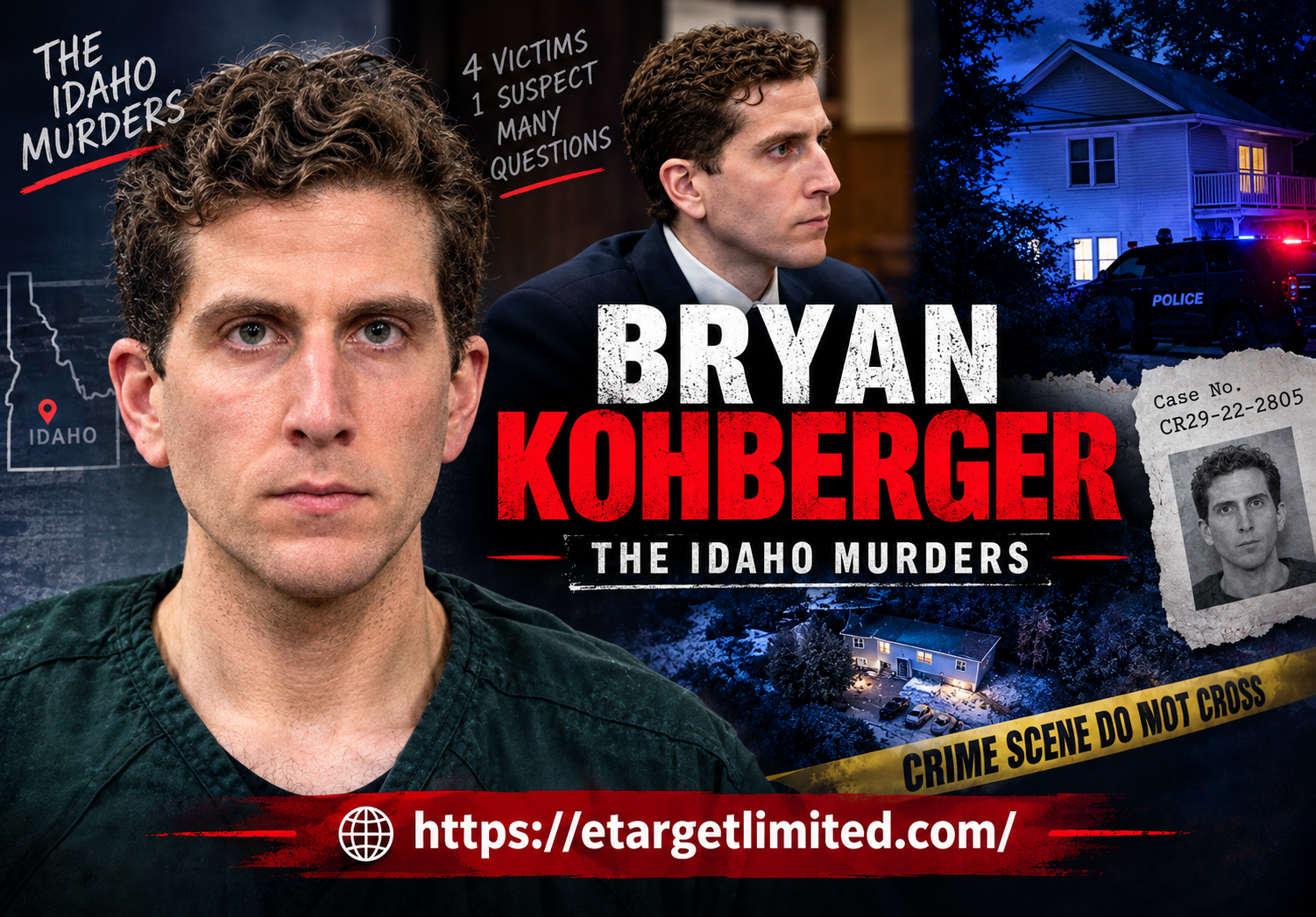
Bryan Kohberger became nationally known after the November 2022 killings of four University of Idaho students in Moscow, Idaho. The case attracted enormous attention because of the victims’ ages, the unusual investigation, the eventual arrest of a criminology student and the evidence investigators said connected him to the crime. Kohberger later pleaded guilty and received four consecutive life sentences without parole. In 2026, however, he began trying to withdraw that guilty plea and pursue a trial.
Who Is Bryan Kohberger?
Bryan Christopher Kohberger was born on November 21, 1994, in Pennsylvania. Before his arrest, he had developed an academic interest in criminal justice and criminology. At the time of the killings, he was a doctoral student at Washington State University in Pullman, Washington, only a short distance from Moscow, Idaho.
His educational background became an important part of public interest in the case. Kohberger had studied criminal justice and had experience with academic discussions surrounding crime and law enforcement. However, his education alone does not explain what happened in Moscow or establish a motive.
Kohberger was 28 when authorities arrested him in Pennsylvania in December 2022. He eventually became the defendant in one of the most closely followed murder cases in the United States.
The Idaho Department of Correction currently lists him as 31 years old and in custody at the Idaho Maximum Security Institution. His official correctional record lists four life sentences for first-degree murder.
What Happened to the University of Idaho Students?
The four victims were Madison “Maddie” Mogen, Kaylee Goncalves, Xana Kernodle and Ethan Chapin. Mogen, Goncalves and Kernodle lived in an off-campus home on King Road in Moscow. Chapin was Kernodle’s boyfriend and was visiting the residence.
The killings happened during the early morning hours of November 13, 2022. The case initially had no publicly identified suspect, creating intense concern throughout the university and surrounding community.
Investigators worked to reconstruct the movements around the house and identify the person responsible. Surveillance footage, vehicle information, cellphone records, forensic evidence and other investigative material gradually became important to the case.
The investigation eventually focused on Kohberger, who was living in Pullman while studying at Washington State University. Authorities arrested him at his parents’ home in Pennsylvania on December 30, 2022, several weeks after the murders.
The arrest brought an initial sense of resolution to a case that had generated intense national attention, but many questions remained about why the students were targeted and whether Kohberger had any previous relationship with them.
Bryan Kohberger Evidence and the Investigation
The evidence discussed during the investigation included DNA, cellphone information, surveillance footage and information concerning a white Hyundai Elantra.
One particularly important piece of physical evidence was a knife sheath found at the crime scene. Investigators said DNA associated with Kohberger was recovered from the sheath. The evidence became an important part of the prosecution’s case as investigators worked to connect him to the King Road residence.
Cellphone records also received considerable attention. Investigators examined Kohberger’s phone activity and movements in the period before and around the killings. Surveillance footage and information concerning a white Hyundai Elantra provided another part of the investigative picture.
The evidence was not limited to one discovery. Instead, investigators assembled different types of information that prosecutors later used to build their case.
Kohberger’s defense had challenged aspects of the prosecution’s evidence during the pretrial period. Some evidence and arguments were heavily litigated, while other material remained subject to court restrictions or sealing.
Because Kohberger eventually pleaded guilty, a jury never heard the complete evidentiary case in a conventional murder trial. This distinction is important when discussing the evidence because some claims made during the investigation were never tested before a jury.
Did Bryan Kohberger Know the Victims?
One of the biggest unanswered questions has been whether Bryan Kohberger personally knew Madison Mogen, Kaylee Goncalves, Xana Kernodle or Ethan Chapin.
No confirmed close personal relationship between Kohberger and the four victims has been publicly established. His proximity to the University of Idaho through his studies at Washington State University generated speculation, but being geographically close to Moscow does not by itself demonstrate that he knew the students.
The question became especially important because investigators never publicly established a simple explanation such as a personal dispute or documented friendship.
The case therefore left many people asking how Kohberger could have selected the King Road house if he did not have a known relationship with its occupants.
The available public record has not provided a definitive answer.
This is also connected to questions about why Madison Mogen and Kaylee Goncalves may have been targeted, whether the house itself was selected for a specific reason and whether Kohberger had previously observed the residence.
Those questions remained unresolved even after his guilty plea.
Bryan Kohberger Motive: Why Did He Do It?
The motive remains one of the most difficult parts of the case.
People continue to ask why Bryan Kohberger committed the murders, why he targeted these particular students and why he went to the King Road residence. Despite the extensive investigation, no definitive public explanation has established his motive.
Moscow Police Chief Anthony Dahlinger later acknowledged that investigators had not been able to answer the fundamental question of why the four students or that particular house were targeted.
Various theories have circulated online. Some have focused on Kohberger’s academic interest in criminology, while others have proposed theories involving personal relationships, surveillance, rejection or an interest in committing a difficult crime. These theories should not be confused with established facts.
Kohberger did not provide a detailed public explanation of his motive when he pleaded guilty in 2025.
That means searches such as “why did Bryan Kohberger do it?” and “what was Bryan Kohberger’s motive?” still do not have a confirmed answer.
His later claim of innocence also adds another layer to the story, but that claim does not itself establish what happened or provide a new explanation for the killings.
Bryan Kohberger Trial and Guilty Plea
Kohberger’s case was originally moving toward a major criminal trial. Prosecutors had sought the death penalty, and the proceedings were expected to involve extensive testimony and forensic evidence.
Instead, Kohberger changed the course of the case in 2025.
Under a plea agreement filed in July 2025, he pleaded guilty to four counts of first-degree murder and one count of burglary. The agreement removed the possibility of a death sentence.
During the change-of-plea hearing, Judge Steven Hippler questioned Kohberger about whether he was pleading guilty because he was actually guilty. Kohberger answered yes.
He also acknowledged the charges involving each of the four victims.
The guilty plea meant there was no full jury trial in which prosecutors had to prove every element of the case beyond a reasonable doubt before a jury.
For many observers, the plea answered the question of legal responsibility but left other questions unanswered. Most notably, it did not explain the motive.
Bryan Kohberger Sentencing and Prison
On July 23, 2025, Kohberger was sentenced to four consecutive life terms without parole for the murders. He also received a 10-year sentence for burglary.
The sentence followed his decision to accept the plea agreement rather than face the possibility of a death sentence at trial.
His current Idaho Department of Correction record confirms that he remains in custody and lists life sentences connected with the four murder convictions.
Kohberger is being held at the Idaho Maximum Security Institution near Boise. His official correctional record lists his status as in custody.
Questions about his prison life have also attracted considerable public interest. However, detailed information about his daily routine, visitors and specific institutional conditions is limited. Correctional rules can also change depending on security classifications and individual circumstances.
His incarceration was expected to last for the remainder of his life unless his conviction or sentence is successfully changed through the legal process.
Bryan Kohberger Family, Parents and Sisters
Kohberger’s family has remained part of the story since his arrest. His parents and sisters have faced substantial media attention because of the case and his subsequent legal proceedings.
His family has supported him throughout the legal process. In 2026, relatives also supported his attempt to challenge the guilty plea.
His sisters have attracted particular public interest, with searches often focusing on whether they suspected him, what they knew and what they have said about him.
There is no established evidence that his sisters knew he was responsible for the murders before his arrest. Online speculation should therefore be separated from documented statements and court records.
The family’s position also does not determine the legal outcome. Their support for Kohberger’s current challenge is a personal position, while the courts must determine whether his legal claims satisfy the requirements for post-conviction relief.
Bryan Kohberger Update: His 2026 Legal Challenge
The biggest development in the Bryan Kohberger case during 2026 has been his attempt to withdraw his guilty plea.
In July 2026, Kohberger filed a handwritten post-conviction petition claiming that his lawyers provided ineffective assistance and that he was pressured into pleading guilty. He has claimed that his plea resulted from coercion, misinformation, alleged false promises and the withholding of evidence he considers potentially exculpatory.
Kohberger has also publicly claimed that he is innocent and wants a trial.
This is a significant change from his position in July 2025, when he admitted guilt in court and accepted the plea agreement.
His current claims are allegations made in his post-conviction proceedings and have not been established as facts by a court.
The court has allowed the post-conviction process to move forward. A potential evidentiary hearing has been scheduled for June 2027, while additional proceedings are taking place before then.
In September 2026, another hearing was scheduled for October 15 concerning the defense’s effort to disqualify Judge Hippler from handling the post-conviction case.
Kohberger has also received new court-appointed representation for the post-conviction proceedings.
Bryan Kohberger Documentary and Public Interest
The case has generated documentaries, books, podcasts, television coverage and extensive online discussion.
One of the most notable recent productions is Netflix’s three-part documentary The Idaho Murders: College Nightmare, which premiered in July 2026. The documentary revisits the killings, investigation, victims and aftermath.
The renewed documentary attention arrived at the same time that Kohberger was challenging his guilty plea, making the case especially prominent again.
Documentaries can provide useful background, interviews and timelines, but they may also include interpretations from journalists, investigators, lawyers or other participants. Viewers should distinguish those interpretations from court-established facts.
The continued interest in the case also explains why searches for Kohberger’s photographs, mugshot, car, knife, crime scene and family remain popular.
Some images and claims circulating online are unverified or taken out of context, so they should not automatically be treated as reliable evidence.
What Happens Next for Bryan Kohberger?
Kohberger’s future now depends heavily on the outcome of his post-conviction proceedings.
His current legal position is unusual because he previously admitted guilt, accepted four consecutive life sentences and waived certain appeal rights, but he is now arguing that the plea should be withdrawn.
His attorneys will have to present legal arguments supporting his claims, while prosecutors can oppose the petition.
The court will ultimately determine whether his allegations justify further relief.
As of September 2026, there is no new murder trial underway. Kohberger remains convicted and incarcerated. His request for post-conviction relief has not resulted in the existing convictions being erased.
The upcoming proceedings could determine whether the case moves into another major phase, but that outcome has not yet been decided.
Conclusion
The Bryan Kohberger case has changed significantly since the murders of Madison Mogen, Kaylee Goncalves, Xana Kernodle and Ethan Chapin in November 2022. Kohberger was arrested after a major investigation, pleaded guilty in 2025 and received four consecutive life sentences without parole.
Yet the case continues to raise questions, particularly about motive and the absence of a clearly established relationship between Kohberger and the victims.
The latest development is his 2026 attempt to withdraw his guilty plea. Kohberger now claims that his plea was improperly obtained and says he is innocent, despite having admitted guilt in court in 2025. Those claims remain part of an ongoing legal process.
For now, the established position is that Bryan Kohberger remains convicted and imprisoned at the Idaho Maximum Security Institution. His post-conviction challenge is still developing, with further court proceedings scheduled as the legal process continues.