
Shia LaBeouf Tattoo and His Commitment to Acting
Shia LaBeouf has developed a reputation for taking unusual approaches to preparing for demanding movie roles. His tattoos are part of that larger history. Director David Ayer, who worked with LaBeouf on Fury and The Tax Collector, has repeatedly described the actor as exceptionally committed to his characters. Ayer said that LaBeouf had a tooth pulled while preparing for Fury and later had his chest tattooed while working on The Tax Collector.
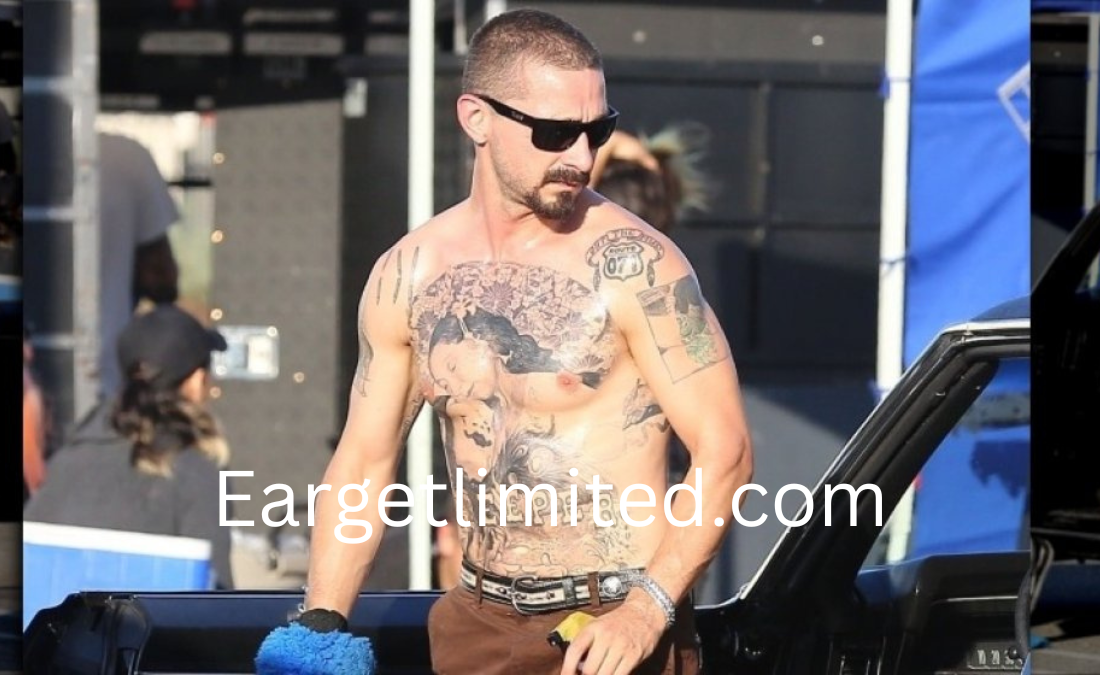
The tattoo became one of the most talked-about aspects of LaBeouf’s appearance in The Tax Collector. In the movie, he played Creeper, an intimidating enforcer working in the criminal underworld of Los Angeles. His heavily tattooed appearance helped establish the character before he even spoke. When early photographs from the production appeared, the large word “Creeper” across his stomach immediately attracted attention. The tattoos looked so elaborate that many viewers assumed they had been created with makeup or special effects.
The reality was considerably more permanent. LaBeouf’s front torso was genuinely tattooed, making his physical transformation for the role particularly unusual.
The Real Shia LaBeouf Chest and Torso Tattoo
The most famous Shia LaBeouf chest tattoo is actually a large collection of designs that cover much of his front torso. It extends from the upper chest toward the stomach and combines portraits, flowers, lettering and other imagery into one extensive composition. Tattoo artist Bryan Ramirez was involved with the work and confirmed that the tattoo was real.
The tattoo has an important personal element. According to Ramirez, the upper part of the design was inspired by LaBeouf’s parents. Two portraits are incorporated into the artwork, surrounded by decorative elements. The lower portion contains the name “CREEPER,” directly connecting part of the tattoo to the character LaBeouf played in The Tax Collector.
This explains why the tattoo sometimes appears to be described as both a personal tattoo and a movie tattoo. It is really a combination of the two. The design contains imagery connected to LaBeouf’s family while also incorporating his fictional character.
The Los Angeles Times reported that LaBeouf visited Reservoir Tattoo Studio in Echo Park while preparing for The Tax Collector. Ramirez described the finished work as an entire front-torso collection of tattoos that incorporated barrio-inspired imagery, portraits, flowers, lettering and the word “CREEPER.”
Shia LaBeouf Creeper Tattoo Meaning
The Shia LaBeouf Creeper tattoo is closely associated with The Tax Collector, but its meaning is not limited to the character. “Creeper” is the name of LaBeouf’s character, and the word is prominently incorporated into the lower portion of his torso tattoo.
The upper part has a much more personal connection. Ramirez explained that the portraits and imagery were inspired by LaBeouf’s mother and father. This makes the tattoo different from a typical temporary movie tattoo because it combines the actor’s real life with the fictional world of the film.
There is also an important detail concerning the timing. Although David Ayer spoke about LaBeouf getting his chest tattooed for The Tax Collector, Ramirez indicated that the chest piece had actually been developed through continuing tattoo sessions over a much longer period. In a statement associated with his work, Ramirez said the chest piece had begun around the time of Holes and continued through additional sessions.
Therefore, the simple statement that LaBeouf got an entire tattoo from scratch solely for The Tax Collector does not tell the complete story. The movie clearly influenced the final form of the piece, particularly the incorporation of “CREEPER,” but the tattoo itself had a longer history.
Did Shia LaBeouf Really Get a Tattoo for The Tax Collector?
Yes, the large torso tattoo associated with The Tax Collector is real. Director David Ayer specifically discussed LaBeouf’s decision to tattoo his chest, while Ramirez confirmed that the tattoo was genuine.
This is why questions such as whether the Shia LaBeouf tattoo for the Tax Collector was real have continued to attract attention. Actors regularly wear temporary tattoos when a character has extensive body art, because makeup can reproduce almost any design without permanently changing the performer. LaBeouf’s case was different.
The commitment was particularly striking because his character spends much of the movie wearing clothing that covers a significant portion of the tattoo. The tattoo therefore was not simply a visual effect designed to impress viewers in every scene. It was part of LaBeouf’s personal physical transformation.
TheWrap noted that there was some confusion at the time over how much of the tattoo was real, but subsequent comments from the tattoo artist and director provided strong confirmation that the major torso work was permanent.
Shia LaBeouf Back Tattoo, Face Tattoo and Other Body Ink
Interest in the Shia LaBeouf back tattoo comes partly from the fact that his collection extends well beyond the famous chest piece. Photographs of the actor over the years have revealed tattoos across his arms, hands, shoulders, legs and other areas.
However, the back and face tattoos are less clearly documented than the major Creeper torso design. Online tattoo references have identified smaller pieces around his ear, shoulder and other parts of his body, but not every design has a confirmed explanation from LaBeouf himself. This is important because internet discussions often treat interpretations as established facts.
The same issue applies to searches about a Shia LaBeouf face tattoo or Shia LaBeouf tattoo on face. Certain photographs show markings around the ear and head area, but it is difficult to establish the meaning of every small tattoo without a direct statement from the actor.
Movie appearances can also create confusion because makeup, scars and temporary character markings may resemble permanent tattoos. For that reason, the large Creeper torso tattoo is much easier to verify than some of the smaller designs around LaBeouf’s head and face.
Shia LaBeouf Finger Tattoo, 071 Crew and Bakersfield
Among LaBeouf’s smaller tattoos, the 071 Crew Shia LaBeouf tattoo has generated considerable discussion. “071 Crew” has been associated with his finger tattoos and is often discussed alongside “Bakersfield.” Online tattoo references connect these designs with LaBeouf’s childhood and California background, although the precise meaning of every part has not been definitively explained by him.
The Bakersfield reference has been linked to his father, who worked at a prison in Bakersfield during LaBeouf’s childhood. This gives the location a personal connection rather than automatically making it a reference to a gang.
The “071 Crew” tattoo is sometimes interpreted online as evidence of gang affiliation, particularly because of the criminal themes surrounding The Tax Collector. That interpretation should be treated cautiously. A tattoo containing the word “Crew” does not by itself prove membership in a real-world gang.
This distinction matters because LaBeouf’s fictional role as Creeper has caused some of his real tattoos to be viewed through the lens of the movie. His actual tattoos existed independently of the fictional criminal organization portrayed on screen.
Shia LaBeouf 1986–2004 Tattoo and Personal Meaning
One of LaBeouf’s oldest and most personally meaningful tattoos is the 1986–2004 design on his wrist. Unlike the Creeper tattoo, this one has a clear explanation directly from LaBeouf.
In interviews, he explained that 1986 represents his birth year and 2004 represents the point when he considered his childhood to have ended. He described the tattoo as a reminder of the childhood he felt he had lost while working as a young actor.
LaBeouf began acting professionally at a young age, and his childhood was unusual compared with that of many people his age. He has spoken about growing up quickly and taking on responsibilities early. The tattoo therefore serves as a personal timeline.
This is one of the clearest examples of the deeper meaning behind the Shia LaBeouf tattoo collection. His tattoos are not simply decorations. Some represent specific periods, people and experiences that influenced his life.
The 1986–2004 tattoo also demonstrates why the actor’s tattoos should not all be interpreted through his movie roles. Many of them existed long before The Tax Collector and represent his own history.
Shia LaBeouf Hand, Arm, Leg and Music Tattoos
LaBeouf’s tattoo collection includes several pieces connected to music and personal interests. His arms and hands feature a mixture of religious, artistic and personal designs, while his legs contain some particularly recognizable tributes to musicians.
One of the most unusual stories involves Missy Elliott. During the period associated with American Honey, LaBeouf ended up getting two Missy Elliott tattoos. The FADER reported that he and people around the production visited tattoo shops, and LaBeouf later discussed how peer pressure contributed to him getting the tattoos.
His leg tattoos have also been associated with musicians such as Tupac Shakur and Prince. These designs show how varied his tattoo collection is. They are not connected to a single movie or character but instead reflect cultural influences and people he admired.
LaBeouf also has religious imagery. His hand tattoo and other designs have been discussed in relation to his spiritual experiences. This contributes to a collection that ranges from childhood memories and family references to music, faith and acting.
Another unusual design associated with him is a giraffe riding a bicycle. The whimsical image contrasts sharply with the intimidating Creeper artwork and demonstrates how different the styles within his tattoo collection can be.
Shia LaBeouf Tattoo Removal and New Tattoo Questions
Because the Creeper tattoo was created for a movie role, many fans have wondered whether Shia LaBeouf tattoo removal ever became necessary after filming. There is no strong evidence that the large torso design was completely removed. Permanent tattoos are difficult and expensive to erase, requiring multiple laser treatments over an extended period, and the Creeper artwork has remained a recognizable part of LaBeouf’s tattoo history.
Questions about a Shia LaBeouf new tattoo have also appeared whenever new photographs reveal more of his body art. However, not every tattoo that appears in a newer photograph is necessarily new. Changes in clothing, photography and visibility can make older tattoos appear to be recent additions.
The major tattoo story remains the extensive front-torso work associated with The Tax Collector. Its significance comes from both its permanence and its combination of personal and fictional imagery.
Conclusion
The story behind the Shia LaBeouf tattoo collection is much more interesting than the idea that the actor simply got tattoos to look tougher for a movie. His body art represents several different parts of his life. The large Creeper torso tattoo became famous because of The Tax Collector, but the work also contains portraits inspired by his parents and had a longer development through multiple tattoo sessions.
His other tattoos provide a more personal timeline. The 1986–2004 tattoo represents his childhood and the transition into adulthood, while the Bakersfield and 071 references have been connected to his upbringing. His music-related tattoos, including the Missy Elliott pieces, show another side of his interests.
The most important fact is that the famous Shia LaBeouf chest tattoo connected to Creeper is real. It was not simply painted onto his body for filming. David Ayer’s comments and Bryan Ramirez’s confirmation establish that the tattoo was a genuine and permanent piece of body art.
At the same time, some claims about his face tattoos, back tattoos and supposed gang connections remain less certain. The best way to understand LaBeouf’s tattoos is to separate documented facts from online speculation. Taken together, his tattoos tell a story about childhood, family, music, faith and acting, making his collection one of the more unusual examples of personal body art intersecting with a Hollywood career.